
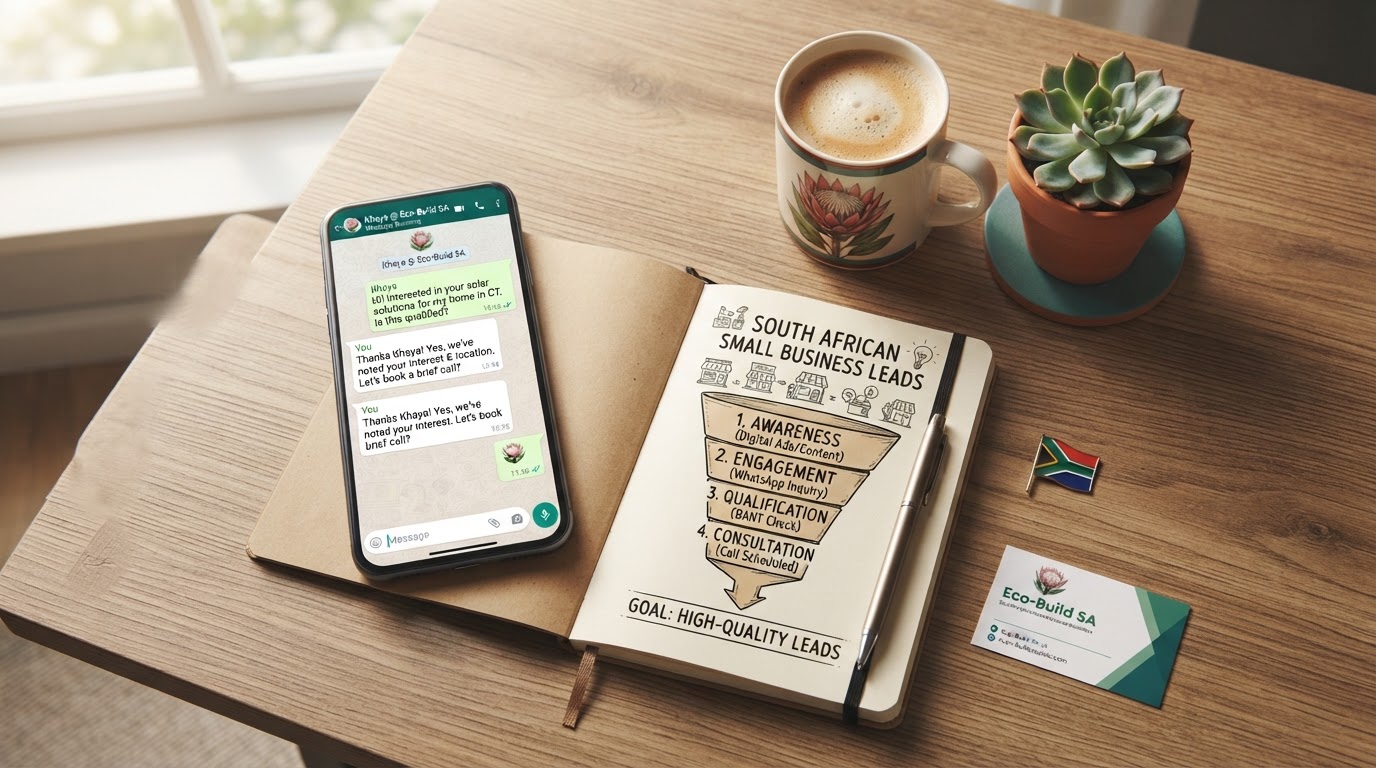
What are qualified leads, really?
Every South African business wants more customers. But not every enquiry is worth your time. Getting more qualified leads is what separates a busy sales team from a successful one.
A qualified lead is a person or company that's likely to become a paying customer. They have a need your product solves. They also have the budget, the authority and the timing to buy. In other words, they're a good fit, and they're genuinely interested.
Compare that with a plain lead. A plain lead might be someone who downloaded a free guide out of curiosity. They could be a student, a competitor or someone who's just window-shopping. That's fine, but they're not ready for a sales call.
Qualified leads matter because your time is limited. When your team speaks to the right people, deals close faster, and you waste less money along the way. With load shedding, rising costs and tight budgets, nobody can afford to chase dead ends.
Marketing qualified vs. sales qualified leads
Most companies use two main labels. Knowing the difference helps you plan better.
A Marketing Qualified Lead (MQL) shows interest through marketing activity, like downloading an ebook or joining a webinar. A Sales Qualified Lead (SQL) meets your fit criteria and is ready for a sales talk, such as requesting a quote or demo. A Product Qualified Lead (PQL) uses a free trial and shows buying signals, like inviting teammates or hitting a usage limit.
An MQL becomes an SQL once your team confirms the person has a real need and the means to buy. Some businesses, especially software companies, also track PQLs.
Why quality beats quantity
It's tempting to chase big numbers. A thousand new contacts sounds great on a report. But if only two of them buy, you've spent a lot for very little.
Focusing on qualified leads gives you shorter sales cycles, higher close rates, a lower cost per customer, happier sales reps who aren't chasing dead ends, and better retention because buyers are a true fit.
Simply put, fewer but better leads usually beat a long list of maybes.
How much does a qualified lead cost in South Africa?
This is one of the most common questions, and the honest answer is: it depends. Your industry, your channel and your offer all change the price. A company selling enterprise software to corporates will pay far more than a local panel beater.
Still, it helps to have a ballpark. In South Africa, costs can range from about R150 to R500 per lead in lower-priced industries, up to R2,000 or more in business-to-business (B2B) fields like financial services, IT or industrial equipment. These are estimates, so use them as a starting point rather than a rule.
Average cost by channel (in rand)
Treat these as rough guides, not promises, because results vary a lot.
Organic SEO and content: R300 to R1,500 per qualified lead, with slow then steady results.
Google search ads: R400 to R2,000, with fast results.
Facebook and Instagram ads: R200 to R1,200, with fast results.
Email and WhatsApp marketing: R100 to R600, with medium-speed results.
Events and trade shows: R1,500 to R5,000 or more, with medium-speed results.
Referrals and partnerships: R150 to R800, with medium-speed results.
Organic channels cost less per lead over the long run, but they take patience. Paid channels give you speed, but the bill keeps coming. Also keep in mind that the rand's ups and downs can affect the price of ads on global platforms, since many are billed in dollars.
How to work out your own number
You don't need fancy software for this. Use a simple formula: cost per qualified lead equals total marketing spend divided by the number of qualified leads.
For example, say you spend R20,000 in a month and get 40 qualified leads. Your cost per qualified lead is R500. Next, compare that number with your customer value. If a new customer is worth R15,000 to you, then R500 per lead is a bargain. If a customer is worth only R800, you'll need to adjust.
Track this number every month. Small improvements add up quickly.
Start with a clear ideal customer profile
Before you do anything else, define who you want to attract. This is called an ideal customer profile (ICP). It describes the type of business or person who gets the most value from what you sell.
Ask yourself: Who are our best current customers? What problems do they have? What industry, size and province or city are they in? What made them choose us?
Once you've got answers, every marketing choice gets easier. You'll know where to advertise, what to write and who to call. Without an ICP, you're basically shooting in the dark.
Build content that answers real questions
Content is a powerful lead magnet. When you answer questions your buyers are asking, they begin to trust you. And trust is what turns a stranger into a customer.
Try blog posts that solve common local problems, such as 'How to choose a solar installer in South Africa'. Add how-to guides, checklists, case studies with real results from South African clients, short videos, webinars, and free tools, templates or calculators.
Be helpful first. Don't push your product in every paragraph. People can tell when they're being sold to, and they'll click away. Also, offer a gated resource now and then, like a detailed template in exchange for an email address or cellphone number. That's how curious readers turn into leads.
Use SEO to attract buyers who are already searching
Search engine optimisation (SEO) brings people to your site who are actively looking for answers. That's gold, because those visitors already have a need.
Find keywords your buyers type into Google. Add local terms, like 'in Cape Town' or 'near Sandton'. Write pages that fully answer each question. Use clear headings and short paragraphs. Make your site fast and mobile-friendly.
That last point matters a great deal here. Most South Africans browse on their phones, and data is expensive. A slow, heavy site will lose visitors quickly. Also, set up your Google Business Profile. It helps local customers find you, call you and read your reviews. For service businesses, it's often the cheapest source of qualified leads you'll find.
Aim for buyer-intent keywords, such as 'best accounting software for small business South Africa' or 'quote'. These attract people closer to a decision.
Make your landing pages work harder
A great ad or article means little if your landing page is confusing. Your page has one job: get the visitor to take one clear action.
Write a headline that states the benefit. Keep your form short, since each extra field lowers sign-ups. Add a bold, clear button, like 'Get My Free Quote'. Show proof, such as reviews, logos and ratings. Display prices in rand and mention VAT where relevant. Remove extra menus and distractions.
Then test it. Change one thing at a time, such as the headline or button colour, and see what works. This is called A/B testing, and it can lift your results by a surprising amount.
Use WhatsApp, email and social proof
WhatsApp is king in South Africa. Adding a 'Chat on WhatsApp' button to your site makes it easy for people to ask a question, and many prefer it to filling in a form. Just remember to get permission first.
Email still delivers strong returns too, because the person has already said, 'Yes, I'm interested.' Send a welcome series that shares your best tips, then follow up with a helpful offer.
Social proof adds even more power. People trust people. So share customer testimonials, star ratings including Google reviews and Hellopeter ratings, case studies with real numbers, and awards or media mentions. When prospects see others succeeding with you, they feel safer saying yes.
Try paid ads, referrals and partnerships
Paid ads, such as Google Ads, Meta Ads or LinkedIn Ads, let you reach buyers quickly. Target carefully by job title, location and interests. That way, you pay for the right clicks rather than random ones.
Referrals are another smart move. South Africans love a recommendation from someone they trust. Ask happy customers for introductions, and consider a small thank-you reward.
Partnerships work well too. Team up with a business that serves the same customers but doesn't compete with you. You can trade guest posts, host a joint webinar or recommend each other. Local business chambers and industry associations can also open doors. It's a win-win.
Score your leads
Attracting leads is only half the job. You also need a way to sort them. Think of it like a funnel. Many people enter at the top, but only the best make it through.
Lead scoring gives each contact points based on who they are and what they do. It helps your team focus on the hottest prospects first. For example: matches your ideal customer profile (+20), visits the pricing page (+15), requests a quote or demo (+30), opens three or more emails (+10), uses only a free email address for B2B (-5), hasn't visited in 60 days (-10).
Set a threshold, say 60 points. Once a lead hits it, they're passed to sales. You can adjust the points as you learn what predicts a sale in your business.
Ask the right questions early: the BANT framework
Sometimes the quickest way to find out if a lead is qualified is to simply ask. Good questions save everyone time. BANT is a classic tool that sales teams have used for years. It stands for Budget, Authority, Need and Timeline.
Budget: Can they afford your solution? Authority: Are they the decision maker, or can they reach one? Need: Do they have a real problem you can solve? Timeline: When do they plan to buy?
If a lead checks most of these boxes, they're likely a strong prospect. Try asking things like 'What's the biggest challenge you're facing right now?', 'What have you tried so far?', 'Who else is involved in this decision?' and 'When would you like to have this sorted?' Keep the tone friendly. You're not interrogating anyone. You're just trying to see whether you can truly help.
Staying on the right side of POPIA
The Protection of Personal Information Act (POPIA) controls how you collect, store and use people's personal details. It applies to your lead lists, forms, emails and WhatsApp messages. The Information Regulator enforces the law, and penalties for breaking it can be serious. The good news is that following the rules also builds trust with your customers.
Get clear consent. Use a tick box that people choose themselves, not a pre-ticked one. Say why you're collecting data and explain how you'll use it in plain language. Make opting out easy, with an unsubscribe link in every email and by honouring 'stop' messages on WhatsApp. Collect only what you need, since fewer form fields also means better conversions. Keep data safe using secure systems and limit who can see lead information. Be careful with bought lists, because unsolicited direct marketing generally requires consent, so purchased lists can land you in hot water.
This article is general information and not legal advice. If you're unsure, speak to a qualified legal professional or check the guidance on the Information Regulator's website.
Aligning sales and marketing
When sales and marketing don't talk, qualified leads fall through the cracks. Marketing may send leads that sales thinks are poor. Meanwhile, sales may not share why deals are won or lost.
Agree on a definition and write down exactly what counts as a qualified lead. Hold regular meetings, even a short weekly catch-up helps. Share feedback so sales tells marketing which leads were great and which were duds. Use shared goals and track revenue together, not just lead counts. Set a response time, because following up within minutes, not days, can make a big difference.
When both teams row in the same direction, the whole process runs smoother. In our experience, this one change often boosts results more than any new tool.
Common mistakes to avoid
Even smart businesses trip up. Watch out for these common pitfalls.
Targeting everyone: if you try to speak to all, you'll connect with none. Long, scary forms: ask only for what you truly need. Slow follow-up: leads cool off fast, so reply quickly. Ignoring data: check your numbers monthly and adjust. Skipping nurture: not every lead is ready today, so keep in touch with helpful emails. Ignoring mobile users: if your site is slow on a phone, you're losing business. Buying cheap lists: bought lists are often outdated and unqualified, and they can create POPIA problems.
The good news is that every one of these is fixable. Pick one, improve it this month, and move on to the next.
Tools that help
You don't need a huge budget to get started. A CRM tracks leads and conversations, with options like HubSpot, Zoho, Pipedrive and Salesforce. An email platform sends and automates emails, like Mailchimp or ActiveCampaign. WhatsApp Business handles customer chats. Analytics shows where leads come from, like Google Analytics. Page builders create landing pages, like Unbounce or Leadpages.
Many of these charge in dollars, so keep exchange rates in mind when you budget. Remember that tools support your strategy. They don't replace it. Start simple, and add more as you grow.
Questions, answered
What is a qualified lead in simple terms?
It's a potential customer who fits your target audience and shows real interest. They have a need, the means to pay and a reasonable timeline to buy.
How much does a qualified lead cost in South Africa?
It varies widely by industry and channel. Many businesses pay between R200 and R1,500, while high-value B2B fields can pay more. Track your own cost per lead and compare it with customer value.
How can I generate more leads for my business without a big budget?
Focus on low-cost channels. Set up a Google Business Profile, write helpful blog content, ask for referrals, build an email list and use WhatsApp Business to follow up quickly. These take effort, but they don't need big ad spending.
How do I know if a lead is high quality?
Check whether they match your ideal customer profile and show buying behaviour, such as visiting your pricing page or asking for a quote. Lead scoring and the BANT questions make this easier.
How long does it take to get more qualified leads?
Paid ads can bring leads within days. SEO and content usually take three to six months to build momentum. Email, WhatsApp and referrals often fall somewhere in between.
Does POPIA stop me from doing lead generation?
No, but it sets rules. You need a lawful reason to use personal information, clear consent for most direct marketing, and an easy way for people to opt out. Follow these steps and you can market with confidence.
Should I buy leads?
Generally, it's not a great idea. Purchased lists tend to be low quality, and the people on them may not have agreed to be contacted, which creates POPIA risk. Earning your leads builds trust and brings better results.
Need help turning traffic into qualified leads?
Explore Local SEO & Lead Services for South African businesses.
Don't wait 24 hours, book your call now
Skip the wait and confirm a free consultation with Jackie right now.
Book your free 10-minute call